Key takeaways
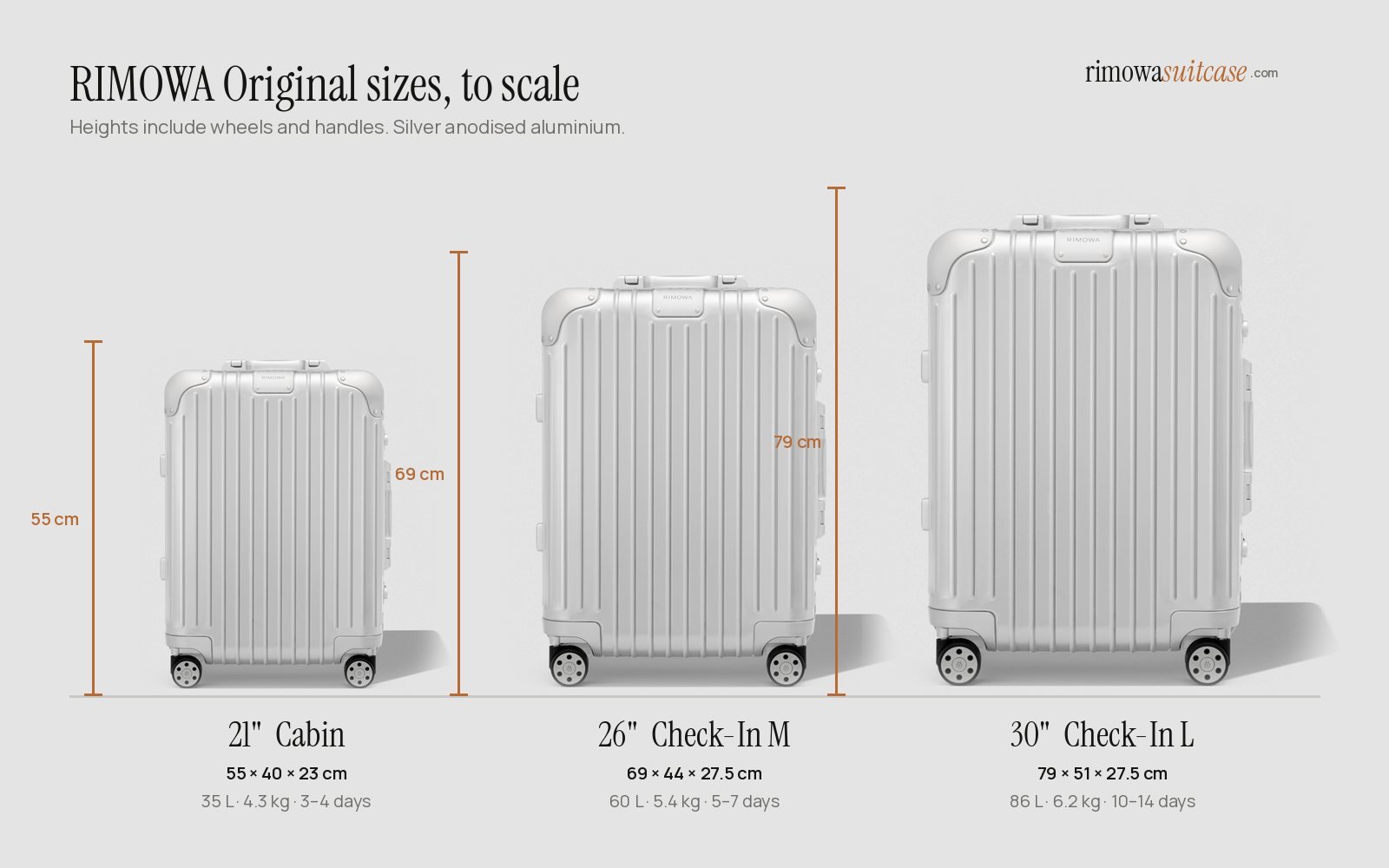
- The RIMOWA Original comes in three core travel sizes: the 21" Cabin (55 × 40 × 23 cm, 35 L), the 26" Check-In M (69 × 44 × 27.5 cm, 60 L) and the 30" Check-In L (79 × 51 × 27.5 cm, 86 L).
- At rimowasuitcase.com the silver Original costs $999 (21"), $1,199 (26") and $1,399 (30").
- Bigger is better value per litre: the 30" works out at about $16 per litre against roughly $29 for the 21".
- RIMOWA suitcases are expensive because of anodised aluminium, in-house manufacturing, replaceable parts and strong resale value — not just the logo.
If you have ever stood in an airport and watched a grooved silver case glide past, you already know the RIMOWA suitcase. What is less obvious is which size to buy, what the dimensions actually mean at the check-in desk, and how much a RIMOWA suitcase should cost in 2026. This guide answers all three, using the published specifications for the silver RIMOWA Original and the real prices we charge for each size.
We sell the RIMOWA Original silver suitcase in three sizes, and we also buy and resell pre-owned RIMOWA, so we see every kind of buyer: first-time carry-on shoppers, frequent flyers upgrading to a large check-in case, and people trying to work out whether a RIMOWA is really worth the money. Here is everything we tell them.
RIMOWA suitcase sizes at a glance
RIMOWA names its sizes by use rather than by inches — Cabin, Check-In M and Check-In L — but most shoppers search in inches, so we list both. Every measurement below includes wheels and handles, which is how airlines measure too.
| Size | RIMOWA name | Dimensions (cm) | Dimensions (in) | Volume | Weight | Ideal trip | Our price |
|---|---|---|---|---|---|---|---|
| 21" | Original Cabin | 55 × 40 × 23 | 21.7 × 15.8 × 9.1 | 35 L | 4.3 kg | 3–4 days | $999 |
| 26" | Original Check-In M | 69 × 44 × 27.5 | 27.2 × 17.3 × 10.8 | 60 L | 5.4 kg | 5–7 days | $1,199 |
| 30" | Original Check-In L | 79 × 51 × 27.5 | 31.1 × 20.1 × 10.8 | 86 L | 6.2 kg | 10–14 days | $1,399 |
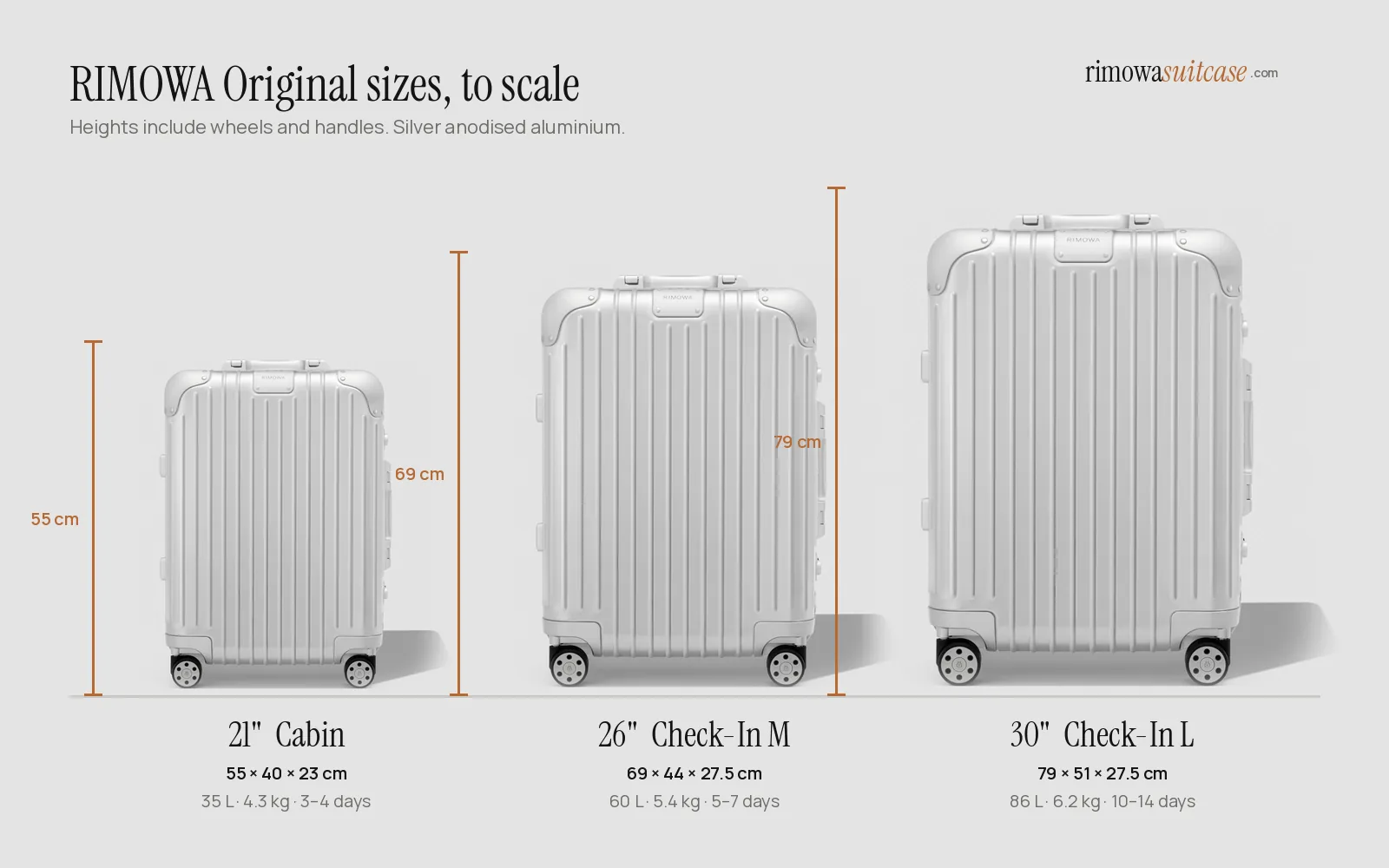
Two details are worth noticing. First, the 26" and 30" share the same 27.5 cm depth; the extra volume of the large case comes from height and width. Second, the inch names are nominal. The “30-inch” RIMOWA actually measures about 31 inches tall with its wheels, which matters if you are comparing it with another brand’s 30" case that is measured without them.
How much is a RIMOWA suitcase in 2026?
The honest answer to “how much is a RIMOWA suitcase?” is: more than almost any other mainstream luggage brand, and the aluminium Original line sits at the top of that range. RIMOWA’s own US store lists the silver Original Cabin at $1,550, and in Europe the Original Check-In M sits around €1,360–€1,400, with the Check-In L higher still at retailers. Aluminium RIMOWA cases generally start around the $1,500 mark and climb steeply for larger sizes, special finishes and collaborations.
Our prices for the same silver Original are:
All three include free tracked and insured shipping within the United States. If you want to spend less again, a pre-owned RIMOWA suitcase with honest wear is the best route — more on that in our used RIMOWA buying guide.
The price-per-litre test
Sticker price is only half the story. Divide the price by the litres you get and the larger RIMOWA suitcases look far better value:

The 21" costs about $28.50 per litre, the 26" about $20, and the 30" about $16. In other words, the 30" gives you nearly two and a half times the space of the carry-on for $400 more. If you travel for longer than a week even a few times a year, that maths is hard to ignore.
The 21" RIMOWA carry-on suitcase (Original Cabin)
The Original Cabin is the RIMOWA suitcase most people picture, and the most searched size by far. It measures 55 × 40 × 23 cm, weighs 4.3 kg and holds 35 litres.
Will the RIMOWA carry-on fit in the overhead bin?
The 55 × 40 × 23 cm footprint matches the most common international cabin allowance used by many European, Middle Eastern and Asian airlines. It also fits the overhead bins on most US domestic flights. The exceptions are a handful of low-cost carriers with smaller sizers and some regional aircraft with shallow bins, where the case may be gate-checked. Always check your airline’s current rules before you fly; they change more often than people expect.
Who the 21" is for
- Business travellers who never want to wait at baggage reclaim.
- Weekenders and short city breaks of three or four nights.
- Anyone building a two-case set — the Cabin pairs naturally with a 26" or 30" check-in case.
A realistic 35-litre packing list for four days looks like this: five shirts or tops, two pairs of trousers, a blazer folded in the Flex Divider, one spare pair of shoes, underwear and socks, a wash bag and a thin laptop sleeve. Packing cubes stretch it further.
The 26" RIMOWA suitcase (Original Check-In M)
The Check-In M is the all-rounder. At 69 × 44 × 27.5 cm it holds 60 litres, weighs 5.4 kg empty and is sized for around a week away. It is the size we recommend to people who own one RIMOWA and want it to cover most trips.
What 60 litres buys you is breathing room. A week of summer clothes fits with space left for shopping; a week of winter clothes fits if you wear your bulkiest layer on the plane. Because it is a checked bag, the dimensions do not matter at the gate — but the weight does. Even fully packed, the 26" rarely gets near the common 23 kg checked-bag limit, which makes it the easiest RIMOWA to live with.
Choose the 26" if you want one case for both short and medium trips, if you travel as a couple who each carry their own case, or if the 21" leaves you sitting on the lid every time.
The 30" RIMOWA large suitcase (Original Check-In L)
The Check-In L is the large RIMOWA suitcase: 79 × 51 × 27.5 cm, 86 litres and 6.2 kg empty. It is built for ten days to two weeks, long-haul family trips, or two people sharing one case.
The one thing to watch with any large suitcase is weight. An empty 6.2 kg case leaves around 16.8 kg for contents under a 23 kg limit, and 86 litres of packed clothes can easily exceed that. A small luggage scale pays for itself the first time it saves you an excess-baggage fee. On the plus side, the Multiwheel® system makes a heavy case feel light on the move, and the stage-free handle means taller travellers are not stooping.

RIMOWA suitcase dimensions explained
Luggage dimensions cause more confusion than anything else we are asked about, so here are the rules that matter:
- RIMOWA measures including wheels and handles. That is the number airlines use, so what you see is what the sizer sees.
- Height × width × depth. 55 × 40 × 23 cm means 55 cm tall, 40 cm wide and 23 cm deep.
- Inch labels are approximate. 21", 26" and 30" are shorthand; the real heights are 21.7", 27.2" and 31.1".
- Volume is not everything. RIMOWA’s two-sided clamshell design with a Flex Divider packs more efficiently than its litres suggest, because nothing has to be crushed under a single lid.
Why are RIMOWA suitcases so expensive?
It is a fair question, and “because of the brand” is only part of the answer. Several things genuinely cost more:
Anodised aluminium and the grooves
The Original’s shell is anodised aluminium, a far more expensive material to form and finish than the polycarbonate or ABS used by most luggage. The famous grooves, introduced in 1950 and inspired by the corrugated fuselage of the first all-metal aircraft, are structural: they stiffen the thin shell so it can stay light without buckling.
In-house manufacturing
RIMOWA produces its cases in its own factories rather than outsourcing to the cheapest supplier, which means higher labour and quality-control costs.
Designed to be repaired
Wheels, handles and locks are replaceable parts. A RIMOWA is designed to last decades rather than a few seasons, and the price reflects that lifespan.
Brand and resale value
Since 2016 RIMOWA has been majority-owned by LVMH, and it is priced as a luxury good. The upside is that well-kept aluminium RIMOWA suitcases hold their value unusually well, which is why we can buy used RIMOWA suitcases from people who are upgrading.
Where are RIMOWA suitcases made?
RIMOWA was founded in Cologne, Germany, in 1898 by Paul Morszeck, starting with wooden suitcases. His son Richard introduced the first aluminium trunks in 1937 — the name RIMOWA comes from Richard Morszeck Warenzeichen — and the grooved design followed in 1950. Today the company is still headquartered in Cologne and says its cases are designed in Germany and produced in its own RIMOWA factories, which are located in Germany, the Czech Republic and Canada.
Are RIMOWA suitcases worth it? Our honest review
We sell them, so take this with that in mind — but we also see the cases that come back to us years later, and that is the strongest argument either way.
Why a RIMOWA is worth it:
- It lasts. Aluminium Originals routinely stay in service for ten years or more.
- It is repairable, so a broken wheel does not mean a new suitcase.
- The Multiwheel® system and stage-free handle are genuinely better to use day to day.
- It holds resale value, so the true cost of ownership is lower than the sticker price.
Why it might not be:
- Aluminium dents. If you want a case that looks new forever, you will be disappointed.
- It is heavier than the lightest polycarbonate cases of the same size.
- A RIMOWA can attract attention, for better or worse.
- The upfront price is high, even at our prices.
A RIMOWA is not the cheapest way to carry clothes. It is one of the cheapest ways to carry clothes for twenty years.
If you take one long trip a year, a mid-range suitcase is probably enough. If you fly monthly, the RIMOWA’s durability and resale value make the case for itself.
Aluminium vs polycarbonate RIMOWA
RIMOWA also makes polycarbonate lines such as Essential, and the Hybrid combines both materials. Polycarbonate is lighter and flexes back from impacts, so it shows fewer dents. Aluminium is stiffer, feels more substantial, develops its famous patina and holds resale value best. If you are buying a RIMOWA for the icon, buy aluminium; if every gram counts, look at polycarbonate.
Finding a RIMOWA suitcase on sale (without getting burned)
Searches for “RIMOWA suitcase sale”, “RIMOWA outlet” and “cheap RIMOWA suitcase” are enormous, and that demand attracts bad actors. A few rules keep you safe:
- RIMOWA rarely discounts the Original. Treat huge discounts from unknown websites with suspicion.
- Ask for real photos and details. A legitimate seller can show the actual case, its interior and its labels.
- Pre-owned is the honest discount. A used RIMOWA in 80–90% condition can save you a substantial amount while still giving decades of use.
- Know what a fake looks like. Our guide to spotting a fake RIMOWA walks through the warning signs.
Which RIMOWA size should you buy? A quick decision guide
- Mostly short trips and you hate checking bags? The 21" Cabin.
- One case for almost everything? The 26" Check-In M.
- Long-haul, family trips or two people sharing? The 30" Check-In L.
- Frequent flyer? The 21" plus either check-in size — the most popular RIMOWA pairing.
And if you want your phone to match your luggage, the RIMOWA aluminium iPhone case ($99 for iPhone 17 Pro Max, 18 Pro and 18 Pro Max) uses the same grooves and the same silver.
Ready to choose? The RIMOWA Original silver suitcase is in stock in 21" ($999), 26" ($1,199) and 30" ($1,399), with free insured US shipping.
Shop RIMOWA suitcasesFrequently asked questions
How much is a RIMOWA suitcase?
RIMOWA’s own US store lists the silver Original Cabin at $1,550, and larger aluminium sizes cost more. At rimowasuitcase.com the silver RIMOWA Original costs $999 for the 21" Cabin, $1,199 for the 26" Check-In M and $1,399 for the 30" Check-In L, with free insured US shipping.
What are the RIMOWA suitcase sizes?
The core RIMOWA Original travel sizes are the 21" Cabin (55 × 40 × 23 cm, 35 L), the 26" Check-In M (69 × 44 × 27.5 cm, 60 L) and the 30" Check-In L (79 × 51 × 27.5 cm, 86 L). All measurements include wheels and handles.
What are the dimensions of the RIMOWA carry-on suitcase?
The RIMOWA Original Cabin measures 55 × 40 × 23 cm (21.7 × 15.8 × 9.1 in) including wheels and handles, weighs 4.3 kg and holds 35 litres.
Is the RIMOWA Original Cabin allowed as carry-on?
Its 55 × 40 × 23 cm size matches the most common international cabin limit and fits most US domestic overhead bins. Some low-cost airlines use smaller sizers, so check your airline before you fly.
Why are RIMOWA suitcases so expensive?
They use anodised aluminium, are made in RIMOWA’s own factories, are designed to be repaired with replaceable wheels, handles and locks, and are positioned as a luxury brand. They also hold their resale value unusually well.
Where are RIMOWA suitcases made?
RIMOWA was founded in Cologne, Germany in 1898 and is still headquartered there. Its suitcases are designed in Germany and produced in RIMOWA’s own factories in Germany, the Czech Republic and Canada.
Are RIMOWA suitcases worth it?
For frequent travellers, usually yes: an aluminium RIMOWA can last decades, is repairable and resells well. If you travel once a year and want a case that never shows dents, a cheaper polycarbonate suitcase may suit you better.
Which RIMOWA size is best for a week?
The 26" Check-In M with 60 litres is sized for around a week. For ten days or more, or two people sharing, choose the 30" Check-In L with 86 litres.
Do RIMOWA suitcases go on sale?
RIMOWA rarely discounts the aluminium Original. Be cautious of very cheap “sale” or “outlet” listings from unknown sellers; a genuine pre-owned RIMOWA is the safest way to pay less.